

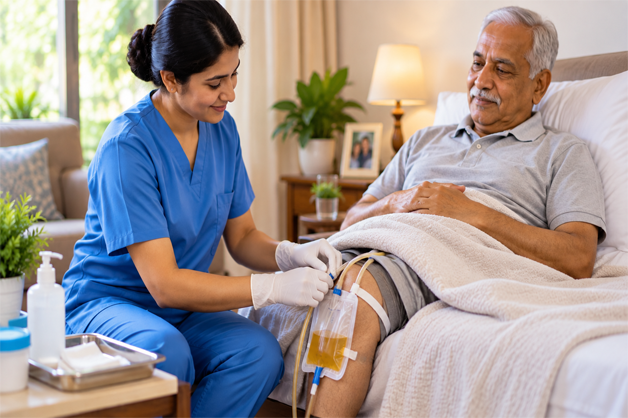
• Wash your hands before and after handling the catheter or drainage bag.
• Keep the catheter and the area around it clean as instructed by the healthcare team.
• Make sure the drainage bag stays below the level of the bladder.
• Avoid pulling, twisting or unnecessarily handling the catheter.
• Check that the tubing is not kinked or compressed.
• Empty the drainage bag as instructed.
• Follow the fluid and medication advice given by the doctor.
• Fever or chills
• Pain or discomfort in the lower abdomen or back
• Blood in the urine
• Cloudy or unusually foul-smelling urine
• Urine leaking around the catheter
• Little or no urine entering the drainage bag
• A catheter that appears blocked, displaced or damaged
• New or worsening discomfort during urination or around the catheter
Yes. Many patients can have their catheter managed safely at home with proper instructions and hygiene. Patients who need assistance may benefit from professional nursing support.
The drainage bag should generally be emptied before it becomes too full. Follow the specific instructions provided by the healthcare professional for the patient.
A Foley catheter should only be removed according to the instructions of a qualified healthcare professional. Do not attempt to remove it without proper guidance.
First, check whether the tubing is kinked or compressed and make sure the bag is positioned below bladder level. If urine still does not drain, especially if the patient has pain or discomfort, contact a healthcare professional promptly.
Yes. A trained nurse can assist with catheter-related care, hygiene, drainage bag management and observation for potential problems, depending on the patient's care plan.

Inhouse Medicare is the most trusted and leading provider of home healthcare services to people of all ages in Coimbatore. We provide timely, high-quality medical care as well as diagnostic services right at your front door.
Doctor Consultation | Skilled Nursing Facilities | Nursing services | Trained Attendant Services | Elder Care Services | Palliative Care Services | End of Life Care | Hospice Care | Stroke Rehabilitation Care | Physiotherapy Services | Laboratory Services | Pharmacy Services | New Born Care | Elder Assistant Services | Geriatric Care Services | Rental Services
Inhouse Medicare
123, Kalidas Road, Ram Nagar, Coimbatore, Tamil Nadu, India, 641009.
© 2026 All Rights Reserved.
Powered by
